White logo on a light background showing a stylized fuel nozzle to the left of the words "FuelResults" in a modern font.

Web Design Fundamentals: A Practical Guide to User-Friendly Websites

by Zach Gosnell
August 1, 2026
Uncategorized
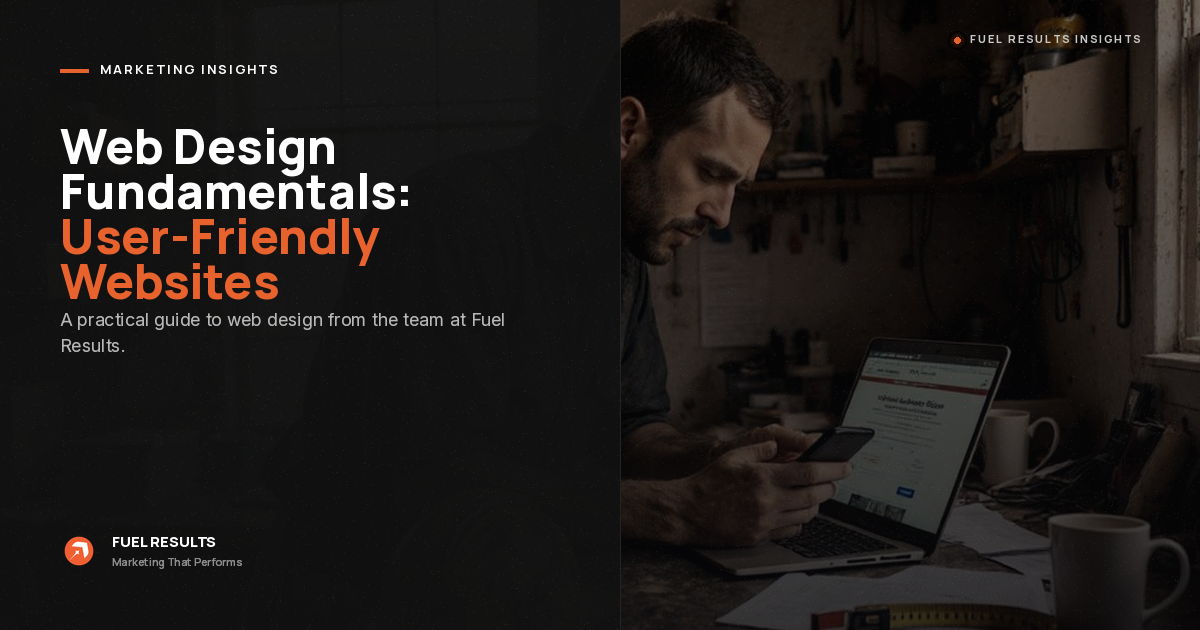
Small business owner reviewing a user-friendly web design on a laptop at the front counter of their shop

Web Design Fundamentals: A Complete, Proven Guide to User-Friendly Websites

⚡ Quick Summary

Good web design is not about how a site looks. It is about how it works for the person using it. Across the marketing campaigns, funnels, and websites we have supported, Fuel Results has helped generate more than $57 million in total client revenue. Here is what actually moves the needle:

  • Great design starts with the visitor’s goal, not the homepage layout
  • Speed, clarity, and mobile-first structure beat flashy animation every time
  • A confusing menu costs you leads before a single word gets read
  • Design for the next click, or the visitor leaves
  • You can learn the fundamentals in weeks, but mastering conversion takes practice

Ask ten people what web design is and you will get ten different answers. Some picture colors and fonts. Others think of code. A few imagine a designer dragging boxes around a screen. All of those are pieces of it, but none of them is the point. Good web design is really the practice of building a website that helps a real person do what they came to do, quickly and without friction, and then guides them toward becoming a customer.

That distinction matters more than most business owners realize. A site can win awards and still lose money. Another can look plain and quietly book calls every single day. At Fuel Results, we have seen both, and the difference almost always comes down to a handful of fundamentals rather than a bigger budget or a trendier style.

This guide breaks those fundamentals down: what the craft really means, the principles that make a site user-friendly, how to design for conversions instead of just compliments, the mistakes that quietly bleed leads, and how you can start learning it yourself.

What Web Design Actually Means

Web design is the process of planning, structuring, and styling a website so that visitors can find what they need and take action. It sits at the intersection of three things: how the site looks (visual design), how it is organized (information architecture), and how it feels to use (user experience). When those three work together, a visitor barely notices the design at all. They just get what they came for.

It helps to separate the discipline from a few things it often gets confused with. It is related to, but distinct from, graphic design, which focuses on static visuals like logos and print. A designer here decides where the button goes and why; a developer writes the code that makes it work. Design shapes the experience; development brings it to life.

The reason this matters for your business is simple. Your website is often the first real impression a prospect gets. Research suggests that people can form an initial opinion about a website’s visual appeal in as little as 50 milliseconds. Clear presentation, professional design, and accessible content can then help strengthen credibility as visitors explore the site.

The Web Design Fundamentals That Make a Site User-Friendly

User-friendly is not a vibe. It is the result of specific, repeatable choices. These are the fundamentals we return to on every project, in roughly the order they affect the visitor.

1. Clear Visual Hierarchy

Visual hierarchy is how a page tells the eye what to look at first, second, and third. Size, color, spacing, and contrast do the work. The most important thing on a page, usually a headline and a single primary action, should be impossible to miss. Everything else supports it. When every element shouts for attention, none of it lands, and the visitor freezes.

2. Fast Load Times

Speed is a design decision, not just a technical one. Heavy images, unnecessary fonts, and bloated plugins can increase loading and processing time, and those delays can cost customers. Google and SOASTA research published in 2017 found that the predicted probability of a mobile visitor bouncing increased by 32% as load time rose from one to three seconds.

Although the exact effect varies by website, device, audience, and connection, a beautiful site that loads slowly still creates unnecessary friction.

53%
of mobile visitors abandon a page that takes longer than three seconds to load. Speed is the first thing a user-friendly design protects.

3. Mobile-First Structure

Mobile devices accounted for more than half of worldwide desktop-and-mobile web traffic in July 2026. Your actual mobile traffic may be higher or lower depending on your industry and audience, so check your own analytics rather than assuming every business has the same split.

Mobile-first means you design for the small screen first and expand up, rather than cramming a desktop layout onto a phone. Thumb-friendly buttons, readable text without pinching, and a menu that works one-handed are non-negotiable. Every website should provide a responsive, accessible experience across phones, tablets, and desktop screens.

Close-up of a mobile-first web design being tested on a phone next to the same site on a monitor
A user-friendly site is checked on the phone first, because that is where most visitors actually land.

4. Intuitive Navigation

Navigation is the map. If a visitor cannot figure out where to go in a few seconds, they may leave. We once audited a site for a Gulf Coast contractor where a customer had to click four times just to find a phone number. Four clicks to call the business. We flattened the menu and put the phone number in the header, making the company’s main contact route immediately visible. Keep menus short, label them in plain language, and make the most common action the easiest one to find.

5. Readable Typography and Breathing Room

Words are still how most sites communicate, so they have to be easy to read. That means comfortable font sizes, generous line spacing, short paragraphs, and enough white space that the page does not feel like a wall. Cramming more onto the screen does not deliver more information; it just makes people stop reading.

Designing for Conversions, Not Just Compliments

Here is where a lot of design work goes sideways. A site can nail every aesthetic detail and still fail the only test that matters for a business: does it turn visitors into leads and customers? A user-friendly site and a high-converting site are not automatically the same thing, but the best design makes them the same thing on purpose.

Conversion-focused design means every page has one clear primary goal and guides the visitor toward it. The main call to action can appear more than once, while relevant secondary actions should support rather than compete with it. Trust signals like reviews and real results should appear where doubt creeps in, and anything that distracts visitors from their next step should be removed. This is the same thinking behind our conversion-focused marketing funnels, where the website is one step in a deliberate path from stranger to customer.

We see the payoff constantly. Business owners who came to us with sites that looked fine but sat silent often did not need a bigger redesign; they needed the design pointed at a goal. If you want proof of what that looks like in practice, we broke down a set of real website design examples that convert and what makes each one work.

“Other companies wanted to build a cookie cutter website, and we wanted something more personalized. I also had concerns with lead generation. Since Fuel Results built our new site, we are getting leads almost every day.”

Magnolia I., Fuel Results client

Common Web Design Mistakes That Quietly Cost You Leads

Most struggling websites are not broken. They are undermined by small, fixable mistakes that add up. The ones we run into most often:

  • No clear next step. The visitor is interested but the page never tells them what to do, so they do nothing.
  • Slow, oversized images. Gorgeous photography that takes forever to load pushes people away before they see it.
  • Hidden contact information. A phone number or form buried three clicks deep loses the exact people ready to reach out.
  • Designing for the owner, not the customer. The site talks about the business instead of solving the visitor’s problem.
  • Ignoring the phone. A layout that only looks right on a desktop fails a substantial part of the audience.

Many of these problems can be improved without rebuilding the entire website. However, the cost and work involved depend on the site’s platform, condition, accessibility, performance, and underlying code. The essential shift is designing from the visitor’s point of view instead of your own, and it is exactly what our professional web design services are built around.

How to Learn Web Design (Without Wasting a Year)

If you want to learn web design yourself, the fundamentals are very learnable. You do not have to master everything at once. Start with principles, then tools, then practice on something real.

Start With Principles, Not Software

Before you touch a design tool, learn how people actually read and use web pages. Study visual hierarchy, contrast, spacing, accessibility, and basic usability. Groups like the Nielsen Norman Group publish decades of research on how real users behave, and it will save you from a hundred pretty-but-useless design choices.

Learn One Tool Well

Pick a single platform and get comfortable. For many small businesses, a modern website builder or WordPress can cover common requirements without writing code. However, the right platform still depends on the site’s functionality, integrations, security, accessibility, maintenance, and performance needs. Learn how to structure pages, place calls to action, and keep things fast before you chase advanced features.

Practice on Real Pages

Rebuild a page you think is weak and try to make it clearer. Ask a friend to find your phone number or book a call, and watch where they hesitate. Those moments of hesitation provide practical design feedback that a course alone cannot replace.

Learning the fundamentals is realistic. Learning to reliably turn a design into revenue, across different industries and audiences, is where experience earns its keep, and it is why many owners eventually hand the work to a team so they can stay focused on running the business.

The Bottom Line on Web Design Fundamentals

Web design is not decoration. It is the practice of removing friction between a visitor and the action you want them to take. Nail the fundamentals, including clear hierarchy, fast load times, mobile-first structure, intuitive navigation, readable content, and accessibility, and you build a site people can use comfortably. Point those fundamentals at a clear goal and you build one that can support business growth.

You do not need the flashiest site on the internet. You need one that respects the visitor’s time and quietly earns their trust. That is what good design does, and it is the standard every page you publish should meet.

Want a Website That Works as Hard as You Do?

Get a free 30-minute strategy session. We will show you exactly where your current site is losing customers and what a user-friendly website could do for your bottom line.

Apply for Your Free Strategy Session
Share this blog with your friends
Zach Gosnell
As Fuel Results’ SEO expert, I’ve built a system that makes Google love our clients and turns organic visitors into paying customers. Because let’s be real, pretty rankings that don’t drive business are just vanity metrics. My approach goes way beyond the standard SEO checklist. While others chase keyword volumes and click data, I combine advanced keyword gap analysis, backlink audits, and competitive content mapping to uncover exactly where opportunities exist. Then I align every piece of content, link, and on-page element with real user intent. The result? Rankings that feel inevitable, because your brand shows up exactly where and when people are looking for what you offer. This methodology was forged through a decade of hands-on experience: co-founding a digital marketing agency, building and scaling competitive e-commerce brands from scratch, and overseeing operations that spanned from SEO strategy to international fulfillment. My edge comes from understanding that modern SEO isn’t just about technical optimization. it’s about how people think, search, and decide. I blend social strategy, content psychology, and community presence to create authority that feels authentic and earns trust, not just backlinks. When I’m not making Google bend to our will, I’m building tools that automate what most agencies still do manually, so our clients can scale faster while staying ahead of the algorithm curve.

Subscribe to our newsletter

Simple, actionable steps you can use today to get more calls, more leads, and more revenue.

E-mail

Categories
AI
CRM/Email Marketing
Marketing Strategy
Podcasts
PPC Ads
Sales Funnels
SEO
Social Media
Websites

Schedule a Consultation

Schedule now

Related Articles

Uncategorized
August 3, 2026

Best Lead Generation Tools for Business Growth: A Complete, Data-Driven Guide ⚡ Quick Take The…

by Zach Gosnell
Uncategorized
August 1, 2026

Web Design Fundamentals: A Complete, Proven Guide to User-Friendly Websites ⚡ Quick Summary Good web…

by Zach Gosnell
Uncategorized
July 28, 2026

Table of Contents Graphic Design Web Design What a Graphic Designer Does What a Web…

by Zach Gosnell
A person walks a dog past a house with a large “For Sale” sign in the yard. Text on the left reads “Lead Generation for Agents: 7 Proven Strategies” with branding from Fuel Results at the bottom.
Uncategorized
July 27, 2026

Lead Generation for Agents: The Proven, Complete Strategy Guide Quick Take Lead generation for agents…

by Zach Gosnell
A person works at a computer in a dark office. Text reads: "Best Web Design Company Sites: Inspiration Gallery. A practical guide from Fuel Results." Logos and navigation are visible.
Uncategorized
July 25, 2026

Best Web Design Company Sites: The Ultimate Gallery of Proven Inspiration When an agency has…

by Zach Gosnell
A person holding a clipboard sits in the driver's seat of a vehicle. On the left, text reads: "The Real Cost for Google Ads in 2026. A practical guide to cost for Google ads from the team at Fuel Results.
Uncategorized
July 21, 2026

Table of Contents What Determines the Cost for Google Ads? Cost Per Click Varies Wildly…

by Zach Gosnell
Image showing a desk with a computer, papers, and coffee in a windowed office. On the left, text reads: "Local SEO vs Traditional SEO: Key Differences" with Fuel Results branding.
Uncategorized
July 20, 2026

Local SEO vs Traditional SEO: Key Differences Explained for Smarter Growth ⚡ Quick Take Local…

by Zach Gosnell
A man holding papers stands by a whiteboard with a marketing channel chart. Text reads: “What About Digital Marketing? Benefits and Best Practices.” The scene is dimly lit, with an industrial, unfinished interior.
Uncategorized
July 18, 2026

What About Digital Marketing? A Complete Guide to Proven Benefits and Best Practices Quick Summary…

by Zach Gosnell
A person works at a desk with a laptop displaying a line graph; text on the left reads, “How to Choose the Best SEO Optimization Agencies” with details about a practical guide by Fuel Results.
Uncategorized
July 14, 2026

Table of Contents Step 1: Define What “Best” Means Step 2: Build a Shortlist Step…

by Zach Gosnell
A man in a suit speaks on the phone at a desk with text: “Mortgage Lead Generation That Works. Proven strategies loan officers use to attract qualified borrowers and close more loans.”.
Uncategorized
July 11, 2026

Mortgage Lead Generation: Proven Strategies That Actually Work ⚡ Quick Take The best mortgage lead…

by Zach Gosnell
A man stands in a dimly lit office near a printer. On the left, text reads: “Google Ads vs Google Ad Manager: Pick the Right Platform. A practical guide to Google Ads Manager from the team at Fuel Results.”.
Uncategorized
July 7, 2026

Google Ads vs Google Ad Manager: One Buys Ads, the Other Sells Them ⚡ Quick…

by Zach Gosnell
A laptop displays marketing data charts on a desk with papers, a pen, and a phone. Text reads: "Google Ads Blocked? Proven Fixes to Restore Ad Delivery" from Fuel Results.
Uncategorized
July 6, 2026

Google Ads Blocked? Proven Fixes to Restore Ad Delivery Fast ⚡ Summary Few things rattle…

by Zach Gosnell
A digital guide cover for "AdWords Google Ads: The Complete Guide to PPC Success" is shown. The right side displays a truck interior with a coffee cup and notepad; the left side has guide details on a black background.
Uncategorized
July 4, 2026

AdWords Google Ads: Your Complete, Proven Guide to PPC Success Quick Summary If you have…

by Zach Gosnell
Split screen with text on the left reading "How to Choose the Right Digital Marketing Ad Agency" and a desk scene on the right showing a hand using a pencil, notebooks, sticky notes, and a computer keyboard.
Uncategorized
June 30, 2026

How to Choose the Right Digital Marketing Ad Agency ⚡ Quick Take Hiring the wrong…

by Zach Gosnell
Uncategorized
June 29, 2026

How to Choose a Near Me Digital Marketing Agency: A Proven, Complete Guide ⚡ The…

by Zach Gosnell
A person working at a computer in a dimly lit room, with the text “Google Ads Editor: Features & Best Practices” and Fuel Results branding on the screen.
Uncategorized
June 27, 2026

Google Ads Editor Guide: Powerful Features and Best Practices for 2026 Quick Take Google Ads…

by Zach Gosnell
A digital banner reads "Lead Generation Explained: A practical guide to lead generation from the team at Fuel Results" with a dark background, orange and white text, and a car interior visible on the right side.
Uncategorized
June 22, 2026

Lead Generation Explained: A Complete Guide for Business Owners Quick Take Lead generation is the…

by Zach Gosnell
Dark-themed image with the title "What Is SEO and How It Drives Business Growth" in large text. A woman sits in a dimly lit corner using a tablet. Logos and branding for Fuel Results appear in the image.
Uncategorized
June 20, 2026

Table of Contents What Is SEO and How Does It Actually Drive Business Growth? ⚡…

by Zach Gosnell
Uncategorized
June 15, 2026

SEO Basics: The Essential Guide Every Business Owner Needs ⚡ The Short Version SEO is…

by Zach Gosnell
Uncategorized
June 15, 2026

SEO-Driven Marketing: How Search Turns Demand Into Qualified Leads ⚡ Quick Take SEO-driven marketing uses…

by Zach Gosnell
Uncategorized
June 8, 2026

Best Website Design Examples: What Makes High-Converting Sites Work ⚡ Key Takeaways The best-looking website…

by Zach Gosnell
Uncategorized
June 6, 2026

Online Lead Generation Real Estate: The Proven, Complete Strategy Guide for 2026 ⚡ The Short…

by Zach Gosnell
Uncategorized
June 4, 2026

Agency Lead Generation: In-House vs Outsourced for Better Leads Quick Take In-house lead generation gives…

by Zach Gosnell
A man wearing glasses sits at a desk with a computer, looking thoughtful. On the left, text reads: “How to Use Google Ads Library for Competitive Research” by Fuel Results. The workspace has papers and a coffee mug.
Uncategorized
May 18, 2026

How to Use Google Ads Library for Competitive Research: A Proven Guide ⚡ Summary The…

by Zach Gosnell
A split-screen image with text on the left reading "Best Digital Marketing Platform for Small Businesses" and a photo on the right of an open laptop on a desk in an office with a whiteboard in the background.
Uncategorized
May 16, 2026

Best Digital Marketing Platform for Small Businesses: 7 Tool Categories That Actually Matter ⚡ Quick…

by Zach Gosnell
Uncategorized
May 11, 2026

Top 15 Best Websites for Web Design Inspiration in 2026 ⚡ Quick Take Looking for…

by Zach Gosnell
A presentation slide titled "Agency SEO Services: How They Work and What to Expect" is displayed on a dark background. Two people sit at a desk near a large screen and a whiteboard with diagrams.
Uncategorized
May 9, 2026

Agency SEO Services: How They Work and What to Expect ⚡ Quick Take Most prospective…

by Zach Gosnell
A man holding a coffee cup works at a computer while a woman looks at his screen. Overlay text reads: "Google Ads Manager Role: Responsibilities & Skills. A practical guide from Fuel Results.
Uncategorized
May 4, 2026

Google Ads Manager Role: Top Responsibilities & Essential Skills ⚡ Summary A great Google Ads…

by Zach Gosnell
Two people work at computers in a dimly lit office. The screen displays data charts. Text reads, "Digital Marketing and SEO: How They Work Together" with a guide from Fuel Results.
Uncategorized
May 2, 2026

Digital Marketing and SEO: How They Work Together ⚡ Quick Take Operators ask whether to…

by Zach Gosnell
A person gestures toward a large screen displaying analytics graphs. Text reads: "Scaling Up Digital Marketing: Agency vs In-House Teams. A practical guide to digital marketing from Fuel Results." Fuel Results logo is at the bottom.
Uncategorized
May 2, 2026

Scaling Up Digital Marketing: Agency vs In-House Teams Quick Take Scaling up digital marketing forces…

by Zach Gosnell
Let’s build a lead machine that never clocks out
No contracts. No confusion. Just high-converting funnels, local traffic, and qualified leads—delivered fast by a team that actually gives a damn.
APPLY FOR YOUR FREE STRATEGY SESSION
Only 4 new clients accepted monthly to maintain quality.

Results Disclaimer Results are not typical. Your results will vary based on your budget, market conditions, competition, and implementation. Testimonial Disclaimer Client testimonials reflect the specific experiences of those customers and may not represent typical outcomes. Earnings Disclaimer Fuel Results Marketing does not guarantee specific revenue increases or profit levels. Platform Compliance All campaigns comply with Facebook Ads policies. We do not engage in practices prohibited by Meta’s advertising guidelines. Data & Privacy We respect your privacy and handle all data in accordance with our [Privacy Policy] and [Terms of Service]. Guarantee Terms Our “Work for Free Guarantee” applies if we do not meet mutually agreed performance KPIs within the first 30 days of your campaign. KPIs, budget requirements, and cooperation expectations will be defined before campaign launch.

Timeline begins once all requested information, materials, and approvals are received and the strategy is approved. Delays in client deliverables will extend the 21-day period accordingly.