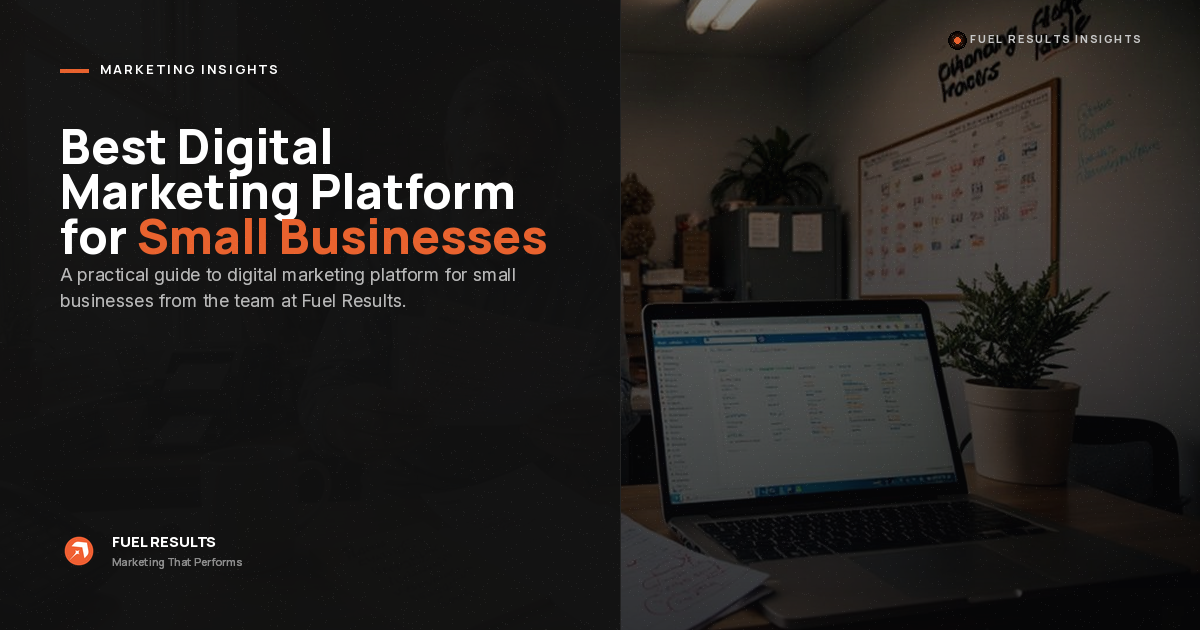


Best Digital Marketing Platform for Small Businesses: 7 Proven Picks for 2026
There is no single “best” digital marketing platform for small businesses. There is a right stack for the way you sell, the customers you serve, and the people you have to run it. The honest playbook in 2026:
- Most small businesses overspend on tools and underspend on the strategy that makes them work
- You need four jobs covered: visibility, capture, nurture, and reporting. Not 14
- The right pick depends on your buyer, not your budget: an HVAC company and a Shopify brand should not run the same stack
- All-in-one platforms save time. Best-of-breed stacks win on results. Both are fine, neither is free
- Switching costs are real. Pick deliberately, then commit for at least 12 months
If you have spent more than ten minutes searching for a digital marketing platform for small businesses, you already know the problem: every software vendor is the “all-in-one” answer, every comparison post is monetized by affiliate links, and every Reddit thread is half opinion and half outdated. At Fuel Results, we have been hired to clean up the aftermath of those decisions for years. The pattern is almost always the same. A founder picked a platform based on a slick demo, paid for it for 18 months, used 12 percent of the features, and never connected it to a real growth number.
This guide is the conversation we would have with a friend opening their first shop or service business in 2026. It covers what a marketing platform actually has to do, the seven categories that matter, how to choose, and the mistakes that cost the most. By the end you will be able to walk into any sales call and ask the questions that separate a tool that will pay for itself from one that will quietly bleed your monthly budget.
What a Digital Marketing Platform for Small Businesses Actually Has to Do
Most “marketing platforms” are really four products in a trenchcoat: a CRM, an email tool, an ad reporting dashboard, and a landing page builder. Before you shop, get clear on the four jobs the software has to do for you. If a tool covers all four, you have an all-in-one. If it covers one or two, it is a piece of a stack.
- Visibility: get your business in front of buyers who are searching or scrolling for what you offer
- Capture: turn that visitor into a contact you can follow up with (a phone call, a form fill, a booked appointment)
- Nurture: stay in front of that contact through email, SMS, or retargeting until they buy
- Reporting: tell you which dollar of spend produced which dollar of revenue, by channel
If a platform you are evaluating cannot draw a clean line from “ad dollar” to “closed customer,” it does not matter how pretty the dashboard is. According to the U.S. Chamber of Commerce small business survey, the operators who feel most confident about their marketing in 2026 are the ones who can name their cost per lead and conversion rate without checking. That is the bar.
The 7 Categories of Tools That Belong in a 2026 Small Business Stack
Rather than recommend specific brand names that will be outdated by next quarter, here are the seven categories every small operator should evaluate. Pick one from each you actually need, leave the rest alone.
Customer Database
The system of record for every lead and customer. The single most important tool you own. Without it, every other channel is shooting in the dark.
Owned Channel
The only audience you can reach without paying a platform tax. Highest ROI for repeat purchase, nurture, and reactivation.
Organic Visibility
Tools that track keyword rankings, audit your site, and surface the content opportunities that move pipeline, not vanity traffic.
Search and Social Buys
Native platforms (Google, Meta, TikTok) handle most of this. A reporting layer on top earns its keep once you spend over $3,000 per month.
Conversion Pages
Fast, mobile-friendly pages built for one offer at a time. Often the difference between a 2% and a 12% conversion rate on the same traffic.
Trust Layer
Automated review requests after every job. The single highest-leverage tactic for local service businesses we work with.
Revenue Attribution
The glue. Pulls spend, leads, and revenue into one view so you stop arguing with yourself about which channel is working.
Most small business owners we audit are paying for 9 to 14 separate tools that overlap on three of these jobs and miss two entirely. The fix is rarely buying more software. The fix is consolidation, configuration, and connecting the pieces you already own to the numbers that matter. Our team approaches this through a data-driven digital marketing strategy that starts with the audit, not the shopping list.
All-in-One Platforms vs. Best-of-Breed Stacks
This is the single most consequential choice in software selection, and almost nobody frames it honestly. Each path has a real cost.
The All-in-One Path
One vendor covers CRM, email, landing pages, reviews, and reporting under one login. Wins: cheaper than the equivalent best-of-breed stack, faster to set up, fewer integrations to break. Costs: each individual feature is a 7 out of 10, not a 10. You will hit a ceiling on email deliverability, landing page speed, or reporting depth as you scale.
This path is the right pick when you are under $1M in revenue, run a tight team of two or three, and need the marketing operation to “just work” while you focus on the product or the trade.
The Best-of-Breed Path
You pick the best tool in each category and integrate them through a workflow tool or a marketing operations partner. Wins: every job is done at a 9 or 10 out of 10. The stack scales without forcing a painful migration later. Costs: more expensive monthly software bill, more time spent on integrations, more dependencies on a competent operator (in-house or agency) to keep the wires connected.
This is the right pick when you are past $1M in revenue, your marketing program is producing a meaningful share of new business, and the cost of a bad lead-routing handoff between systems is now bigger than the savings on the software bill.
How to Choose: A Four-Question Filter
Before you sit through another demo, run any platform you are considering through these four questions. If it cannot answer all four cleanly, keep shopping.
1. Does It Solve a Job You Actually Have?
If the workflow it automates is one you do twice a year, you do not need it. Tools earn their cost when they replace recurring labor or unlock a channel you cannot run by hand. Be honest about the difference between “this looks cool” and “this saves me 8 hours a week or generates 8 extra leads.”
2. Does It Talk to Your Existing Stack?
Specifically: can it push leads into your CRM in real time, fire conversion data back to your ad platforms, and pull revenue from your point-of-sale or invoicing system? If the answer is “via Zapier,” consider that a 4 out of 10. Native integrations beat patched ones every time.
3. Can You Operate It With the Team You Have?
The best software in the world is worthless if nobody in your shop has 90 minutes a week to operate it. Be ruthless. If the demo took 45 minutes just to cover the basics, the daily reality will be heavier than the salesperson is telling you.
4. What Is the Exit Cost?
Every platform you adopt becomes a switching cost. Ask, in writing, how data exports work, who owns your contact list, and what migrating away looks like. Vendors who cannot answer this clearly are usually the ones who are hardest to leave.

The Real Cost of Marketing Software for a Small Business
Honest numbers, because nobody else publishes them. A first credible stack for a service business under $1M in revenue looks something like this:
- CRM with email: $50 to $200 per month
- Landing page builder: $30 to $100 per month, or free if your website already supports it
- SEO tool (for a savvy in-house operator): $99 to $250 per month
- Review automation: $50 to $150 per month
- Reporting / attribution: free if you use GA4 and a spreadsheet, $150 to $400 per month for a connected dashboard
That puts a credible stack at $300 to $1,100 per month before you spend a dollar on advertising. Add $1,500 to $5,000 per month in media spend if you are actually trying to grow. If a vendor pitches an “everything you need” platform at $99 per month, you are not buying a stack, you are buying a brochure.
Common Mistakes That Burn Budget
Mistake 1: Buying the Platform Before the Strategy
Software does not produce strategy. It executes one. Choosing your tool stack before you know who your buyer is, what you are selling them, and how they decide is the most common reason a $400-per-month subscription delivers $0 in revenue.
Mistake 2: Treating Free Trials as Free
Every free trial costs you something: the hours your team spends configuring it, the data you have to move out when you abandon it, the meetings you sit through with the salesperson who keeps emailing. Run trials with intent. Have a decision criterion written down before you start.
Mistake 3: Skipping the Conversion Step
The most common gap we find in small business marketing stacks is not the ad platform. It is the bridge between the click and the close. Investing in marketing funnel systems that convert visitors into qualified leads, with the right landing pages, follow-up sequences, and lead-scoring rules, is usually a higher-ROI move than adding another channel.
"The most expensive marketing platform we have ever seen was the one that the operator never connected to a real revenue number. The cheapest was the one that did."
Mistake 4: Hiring an Agency Without an Owner
If you hire someone to run the stack, somebody on your side still has to own the result. The handful of small business owners we see win consistently with agencies are the ones who can read their own dashboards, ask hard questions in the monthly review, and fire vendors who cannot defend the spend. The platform is a tool. Accountability is yours.
The Honest Bottom Line
There is no single best digital marketing platform for small businesses, and any article that gives you one is selling you a referral fee. The honest answer is that the right stack is the one that covers the four jobs above, fits the team you can realistically staff, and connects every channel to a revenue number you check weekly.
Start with the strategy. Document the buyer, the offer, and the channels you can fund for 12 months. Then pick the smallest set of tools that lets you execute that plan. Resist the urge to buy the next shiny dashboard until the current one is producing measurable pipeline. That sequence, repeated across hundreds of accounts at Fuel Results, is what separates the operators who scale from the ones who keep paying for software they never log into.
If you want a second set of eyes on your current stack or a recommendation grounded in your real numbers rather than a vendor’s affiliate program, our team is set up exactly for that conversation. The first call is free, and the worst-case outcome is that you leave with a clearer picture of what to keep, what to cut, and what one move would move your revenue line the fastest in the next 90 days.